Lower Extremity Venous System Color Doppler Ultrasound
Evaluation of the superficial and deep leg veins for varicose veins, venous insufficiency and clots (thrombosis).
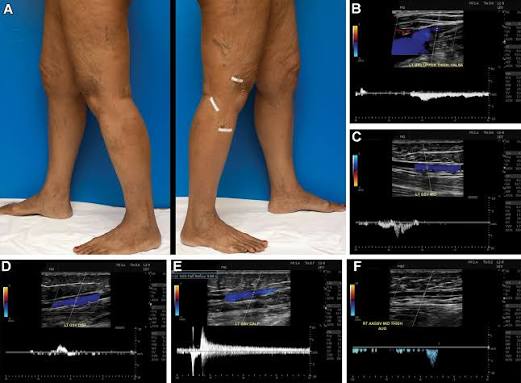
What is the lower extremity venous system and where is it in our body?
The term 'extremity' means 'limb' in medical terminology. The lower extremities refer to the legs and the upper extremities to the arms. The lower extremity venous system is the system of veins that carry the oxygen-poor blood in the legs back to the heart.
The lower extremity venous system extends from the feet along the leg and continues up to the groin region.
What is lower extremity venous system color Doppler ultrasound?
Lower extremity venous system color Doppler ultrasound is an ultrasonographic imaging method used to evaluate the superficial and deep venous system in the legs. Using sound waves, this method visualizes the internal structure of the vessels and blood flow and allows them to be assessed.
Why is lower extremity venous system color Doppler ultrasound performed?
Lower extremity venous color Doppler ultrasound is most often requested in cases of swelling, increased diameter, redness, edema in the legs and the appearance of enlarged vessels.
In patients with signs of venous insufficiency and varicose veins, or in cases where venous thrombosis (clot formation in a vein) is suspected, Doppler ultrasound is the most easily accessible, painless and harmless imaging method for evaluating the veins.
Is there radiation in lower extremity venous system color Doppler ultrasound?
Ultrasound and Doppler ultrasound examinations use high-frequency sound waves. Therefore there is no radiation in these examinations.
Can lower extremity venous system color Doppler ultrasound be performed at any age?
It can be safely performed on patients of any age.
Is any preparation required for this examination?
No special preparation is needed; however, since the veins from the groin down to the ankle are evaluated during the examination, it is recommended to wear clothes that can be easily removed and not to apply cream/lotion to the legs on the day of the examination.
How is lower extremity venous system color Doppler ultrasound performed?
Before the examination, the patient is asked to undress so that the legs are fully exposed. If the assessment is for venous thrombosis, the patient lies on their back on the examination table. Ultrasound gel is applied from the groin to the ankle and the probe is moved along the course of the vein to perform imaging.
For the vessels behind the knee and in the calf, the patient is turned to the side or onto their front. Whether the vessels fill completely and the presence of thrombus formations obstructing flow are examined with color Doppler, and small compressions are applied from time to time.
If venous insufficiency is suspected, the examination is performed while standing. The diameters of the veins are measured, and to determine valve insufficiency the patient is asked to strain or cough so that the amount of reflux is detected.
Why is it important to perform the examination while standing when evaluating venous insufficiency?
Because venous insufficiency becomes more evident under the effect of gravity. In the standing position, the pressure on the vessels increases and valve insufficiency can be observed more easily.
How many minutes does lower extremity venous system color Doppler ultrasound take?
Lower extremity venous color Doppler ultrasound is usually completed within 20–30 minutes. Ultrasound is a painless, non-invasive and easily accessible examination. It contains no radiation and has no known harmful effect on humans.
Is lower extremity venous system color Doppler ultrasound a painful examination?
No, lower extremity venous system color Doppler ultrasound is not a painful examination. This imaging method is performed without any intervention to the body, by applying gel to the legs and moving the ultrasound probe placed on the skin over the leg region.
Does this examination have any side effect or harm?
Lower extremity venous system color Doppler ultrasound is a safe imaging method. As no ionizing radiation is used, there is no risk of radiation exposure.
Is frequent repetition of this examination harmful?
As there is no radiation in ultrasound and Doppler ultrasound, this examination can be repeated as often as needed.
Can I continue my daily life after having this examination?
Immediately after the examination, patients can continue with their work and daily activities. There are no restrictions. The gel used during the examination is water-based and can be easily cleaned off.
What should be done after having lower extremity venous system color Doppler ultrasound?
This is a non-invasive examination and no special post-procedure care is required. You can return to your normal daily activities and will not feel any discomfort.